
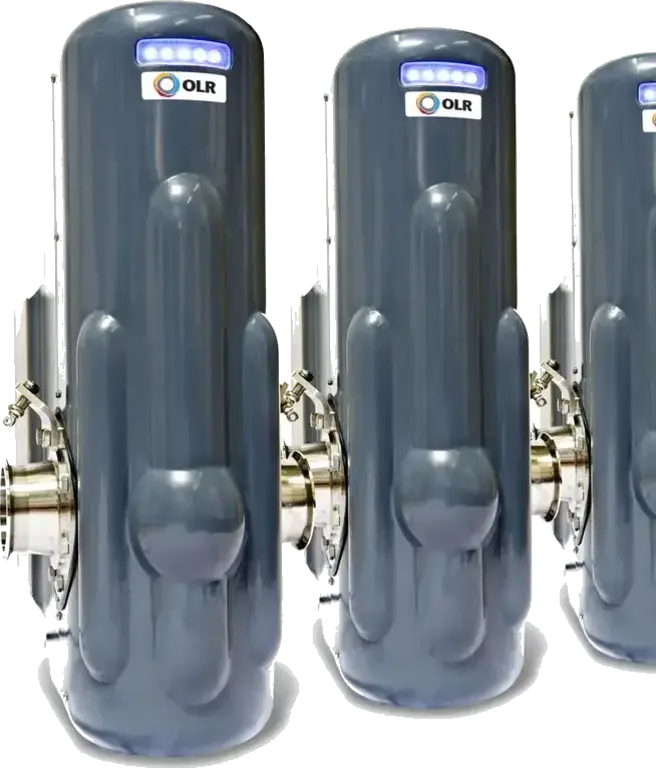
Key Benefits
- Real-time full rheology — continuous G', G'', phase angle, and complex viscosity in the process pipe — not just a single-point viscosity reading
- No sample extraction — squeeze-flow measurement in the process stream eliminates the delay and inconsistency of manual sampling and laboratory analysis
- Mining-rated M2000 variant — ruggedised for concentrated slurries, abrasive underflow, paste backfill, and drilling fluids — rated to 30 bar where conventional sensors fail
- MODBUS PLC integration — direct communication to existing plant control systems for automated process control and out-of-specification alarming
Overview
The OnLine Rheometer (OLR) is an in-pipe process instrument developed by Rheology Solutions (Victoria, Australia) to bring full rheological characterisation into continuous production environments. Using a proprietary squeeze-flow measurement technique, the OLR imposes small cyclic deformations on the process liquid across 1–100 Hz, yielding the complete viscoelastic profile — storage modulus (G'), loss modulus (G''), phase angle (δ), and complex viscosity (|η*|) — the same parameters measured by a benchtop oscillatory rheometer, delivered in real time in the process stream.
Two model series are available. The OLR Series 1000 targets general process industries including food and beverage, cosmetics, pharmaceuticals, petrochemicals, polymers, and advanced materials. The OLR Series M2000 is a ruggedised variant engineered for the extreme conditions of mining and minerals processing — concentrated slurries, underflow streams, paste backfill operations, drilling muds, and fracking fluids — where conventional sensors fail. The M2000 is rated to 30 bar and uses application-specific flow cells for highly abrasive environments.
Data is delivered via SOLR, Rheology Solutions' dedicated process software platform, providing real-time trending, out-of-specification alarms, and diagnostic tools. Direct MODBUS communication integrates the OLR into existing plant PLCs without requiring a separate software system. Installation options include inline (main flow), side-loop (sample returned to stream), and at-line configurations.
Key Features
- Continuous in-pipe measurement of G', G'', phase angle (δ), and complex viscosity
- Proprietary squeeze-flow technology: cyclic deformation across 1–100 Hz
- No moving parts in the flow path
- Series 1000: general process liquids, food, pharma, coatings, polymers
- Series M2000: ruggedised for mining slurries, rated to 30 bar, application-specific flow cells
- Viscosity range: 0.25–200,000 Pa·s
- Temperature range: −10 to 110°C (Series 1000); RTD PT100 Class A sensor
- Installation modes: inline, side-loop, at-line
- SOLR software: real-time trending, alarms, diagnostics
- MODBUS communication to plant PLCs
- Made in Australia (Laverton North, Victoria)
Typical Applications
- Food and beverage manufacturing: real-time viscosity and texture monitoring
- Cosmetics and personal care: continuous in-process gel and emulsion characterisation
- Pharmaceutical production: process analytical technology (PAT) compliance
- Mining: slurry viscosity and yield stress for pumping and pipeline optimisation
- Minerals processing: underflow and paste backfill rheology
- Water and wastewater: sludge treatment monitoring
- Oil and gas: drilling mud and fracking fluid rheology
- Polymer processing: melt and solution flow monitoring
Specifications
| Models | Series 1000 (process liquids), Series M2000 (mining slurries) |
|---|---|
| Measurement | G', G'', phase angle (δ), complex viscosity |η*| |
| Frequency range | 1–100 Hz |
| Viscosity range | 0.25–200,000 Pa·s |
| Force range | 0–44.48 N |
| Temperature range | −10 to 110°C |
| Pressure (Series 1000) | 0.05–10 bar (optional to 30 bar) |
| Pressure (Series M2000) | 0.05–30 bar |
| PLC comms | MODBUS |
| Software | SOLR (real-time trending, alarms, diagnostics) |
| Installation | Inline, side-loop, or at-line |
Frequently Asked Questions
How does the OLR differ from a conventional inline viscometer?
Conventional inline viscometers measure a single-point viscosity at one shear rate. The OLR measures the full viscoelastic profile — G' (elastic component), G'' (viscous component), phase angle, and complex viscosity — across a range of frequencies (1–100 Hz). This provides far more information about material behaviour, including yield stress, structural recovery, and thixotropy, which are critical for process control of complex fluids like slurries, gels, and emulsions.
What is the difference between the Series 1000 and Series M2000?
The Series 1000 is designed for general process liquids in food, pharmaceutical, cosmetics, polymer, and petrochemical industries. The Series M2000 is a ruggedised variant engineered for the extreme conditions of mining and minerals processing — highly concentrated abrasive slurries, high solids content underflow, paste backfill, drilling muds, and fracking fluids. The M2000 is rated to 30 bar and uses application-specific flow cells designed for abrasive environments.
How does the OLR integrate with plant control systems?
The OLR communicates directly to existing plant PLCs via MODBUS, without requiring additional middleware or custom integration work. The SOLR software provides a process-level interface with real-time trending, out-of-specification alarms, and diagnostic tools for operators and process engineers.
Does the OLR require sample extraction?
No. The OLR measures directly in the process pipe using inline, side-loop, or at-line installation — no sample extraction, no laboratory analysis, no measurement delay. This eliminates the inconsistency and lag time associated with manual grab sampling and delivers continuous real-time rheological data.
Related Products
Ready to discuss the OnLine Rheometer?
Talk to our team about specifications, pricing, and availability for your application.